25 January 2014
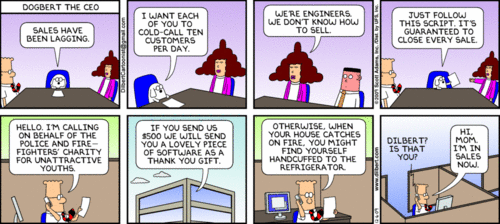
Whether you are a customer or a salesperson, we can all agree on one thing - cold calling is the most unpleasant thing for all the parties involved. If you are a customer, cold calls often tend to happen at the most inconvenient of times. When you are in the middle of an important meeting or waiting for a very important personal call, it’s justifiable if you get infuriated.
On the other end of the line, there could be an equally compelling reason for the sales person to make that unsolicited call. There might be a sensible solution to an age old problem that’s dogging the business. But, there might not be a way to reach the prospect this early in the sales cycle.
Nobody gets a spreadsheet full of leads to follow up and close a deal. Atleast, not every single day. At one point or another cold calling is where a salesperson’s lead generation process and a customer’s purchase process begins. Here’s how both the customer and the salesperson stand to benefit when they engage in cold calling:
Understanding Customer Persona - Cold calls weed out customer types and target segments that aren’t particularly profitable to your business. Let us assume that you are a web design agency and you’re calling local businesses to give their web presence a facelift. When you see that all the salons that you call don’t respond positively and the restaurants do, you’ll know where to focus your resources.
Improve Your Pitch - The probability of closing a cold call deal goes up with the number of calls that you make. After fine tuning your sales pitch to perfection, that is. And, how do you master the art of delivering a stellar sales pitch over the phone to a total stranger? By making calls and learning from trial and error. It’s a vicious circle!
Access to Better Deals - This one is to the advantage of customers. Cold calls aren’t always going to be all about an offer to upgrade your long distance plan. Exclusive deals at a bargain or a highly customized solution to a business requirement come your way more often than you think. Remember, there are always diamonds to be found in the rough!
If done right, cold calling can be a winning strategy for your sales pipeline management. Here are six ways you can improve your unsolicited calling techniques:
Do not blindly start calling up a list of business that you have downloaded online. It isn’t worth your while to buy a database of 100,000 businesses for $10 either. These are the sure fire ways to get your business a bad name.
Put some real effort to cultivate a list of prospects worth your while. Figure out the target segments you plan to attack and work your way through a customer persona. At this stage the persona is going to be all over the place. As you start making calls, the customer personas will start to evolve. You’ll eventually see that managers between the ages of 30 and 50 are more receptive to the idea of getting a new website done by your design studio.
It also helps to stick to a routine. Dedicate one or two hours of a day for making cold calls and no more than that. This will help you stay productive the rest of the day and to keep your conversations fresh over the phone.
Veteran salesmen recommend making calls early in the day. This way, the prospects will be attentive over the call and be willing to lend an ear. Keeping the conversation short and to the point is another advice that’ll prevent you from boring the prospect or wasting your precious time.
A deep understanding about the customer, the business he is in and the potential problems that he might be facing are a must before you start dialling the digits. In addition, it’s extremely useful to know where the prospect fits in the company hierarchy, his ability to make business decisions and his personality.
A VP of Marketing will be more enthusiastic about your pitch to turn their website to a lead generation machine. The Head of Operations might not be as eager to spend money on something that isn’t broken yet!
Knowing more about a customer goes a long way in tweaking your pitch. You’ll have sensible things to talk about and won’t end up asking, “Would you like your website redesigned? We’re good at it!” all the time.
A better approach would be to ask, “Your website is not as engaging as your competition for five different reasons. Would you like to fix that?”. Unless you look beyond the phone number, you won’t have thought provoking questions to pose to a prospect.
The very nature of a cold call gives you only a precious few minutes to make an impression. In under two or three minutes, you’ll have to introduce yourself, get the permission of the prospect to take a few minutes of their time, state your mission, offer a realistic solution and then seek facetime.
To achieve this precision, you’ll have to practise and practise some more. A crisp and precise script will take you successfully half way through the conversation. Yes, it is pointless to use a script for the entire conversation. However, the initial introduction, permission seeking and the closing statements can be turned into a script. This script gets perfected over weeks and months of cold calling taking cues from the prospect’s reaction.
The problem statement and solution suggestion segments of the conversation has to be personalized. Even with a tailormade statement, it is better to write it down and rehearse it a few times before delivery.
Keeping the conversation real without sounding like you’re reciting a script is a skill that’s acquired over time. Even when using a script, try using a couple of phrases and sentences to break monotony in your tone. Doing this also helps to improve the pitch over time.
The advice from experts is to stay away from greeting the customer or ask him how he s doing. Besides taking a few minutes of your time to get to the point, questions like “How are you doing today?” might end up testing the patience of the customer. Who believes that an unsolicited caller is interested in knowing how well things are going at the customer’s end?
If necessary try using humble questions like, “Hope I didn’t catch you at a bad time!”. Politeness and humility is a successful combination. State the urgency of your solution in a manner that justifies the intrusion.
As noted earlier, try out a variety of openers to fixate on a few that the customers respond to without getting annoyed. A semi apologetic tone that justifies the importance of your intrusion is one way to go.
For instance, a statement like, “I apologize if I’m interrupting you at this hour. But, I thought you might be interested to know how you can improve your lead generation efforts by 30%”, is bound to have a profound impact.
This is the moment you convince the customer that you are offering a helping hand to him to solve a nagging problem. Before getting to the part where you explain your background and credentials in detail, offer a solution.
To be precise, follow up the problem statement with a solution. You have already piqued the prospect’s interest with a great problem statement. Now, it’s time to follow up with a brilliant solution to stoke his interest further. Before convincing him that you are right person to get things fixed, convince him that you have a great fix in the first place.
Stating that, “By redesigning the website to remove clutter that hinders user experience and by making your CTAs easily accessible, the conversion rates could double within a month’s time”, is a great way to showcase your experience, confidence and a thorough understanding of the subject matter.
Back this solution with your expertise and credentials. Telling a couple of instances where you’ve helped businesses get over a similar problem will sound far better now. You don’t have to rundown your entire portfolio at this time either. Just limit it to two or three scenarios and problems that the prospect can relate to.
Sprinkle the conversation with your USPs and how effective your solutions are from the competition. Be honest and forthcoming if the customer wants to know more about your offering.
If a customer hasn’t hung up the call by now, you have a real shot at closing this lead. Your agonizing cold call is now over and you are stepping into the good old sales cycle!
Start the call with a goal in mind. In most cases, it’s all about getting facetime, and if that’s your goal as well, go for it!
A lot of active listening is needed to actually get a customer agree to spend some more time with you. Keep your ears open and watch out for signs if the customer is getting uninterested.
Offer him a lot more than an extended version of the same conversation when you meet him. Get him hooked by offering an incentive to make that meeting a reality. Ask him straight away, ”Why don’t we meet up in person and discuss this in detail? I’ll able to give you a quick demo of our product as well.”.
After getting facetime, you’ll initiate the first step in the purchasing process. Be prepared to keep sales management pipeline smooth to avoid any bottlenecks during the buying process.
Before getting to that, start to keep a record of all the cold calls that you make. Note down your thoughts on each call, track how long each call lasts and the point in the conversation the prospect loses interest. Use a CRM to stay on top of this data mine and work on improving your pitch from the insights that you derive!