12 November 2013
Closing deals is a tough gig. A lot of hard work, time and money is spent even on those deals that go sideways. But, the good news is it is actually very easy to uncomplicate the sales process by applying some good old common sense. And, you don’t have to move mountains or rewrite business processes for sales pipeline management either!
Even little things make a lot of difference. Take for instance customer intelligence. It’s a sign of great salesmanship if you jump right into the sales mode as soon as you get hold of a lead. I’m sure you do a little bit of research about the domain the potential customer is operating in, the nature of the competition among other things.
However, you still aren’t prepared enough to close the deal. The big question is - does this lead fit into your target customer profile?
Customer profiling is a market research strategy that helps you find who your best customers are, what they are into, where to find them and how to find more like them. By defining who your ideal customer is, you take guess work out of off the equation. You’ll have a better understanding of how your customers think, feel and behave.
Despite sounding fancy, customer profiling is just an extended version of the research that you do when you come across leads. Except that you apply it to identify a bigger target audience that works for your business!
Most businesses skirt around the concept of customer profiling for one of two things. Either they want to sell to more people or they don’t want to narrow their focus. Unfortunately, they’re not correct and in reality, the opposite is true. Here’ why:
More Opportunities - Customer profiling is the easiest way for you to become a specialist in your line of business. You can fine tune your offerings and messaging to fit the needs of your audience. A customer will be more inclined to choose you over your competition, thanks to your in depth understanding of their issues.
Targeted Messaging - With a well researched customer profile in hand, you can target customers better by way of unified messaging across all channels - print, online and social. Your brand stands to benefit a lot by way of pushing personalized content and messages to your target audience. You’ll quickly move from generic pitches to creating customer experiences around your brand.
Better Communication - Since you understand the way your customers think, you are in a much better position to help them out. It becomes easier for the customers to talk to you and for you to actively listen to their concerns. With such a rapport, you are better placed to build lasting relationships with your customer.
Increased Productivity and RoI - You don’t have to whack around the bush to get to the point any more. It’ll take far less time and money to close deals and create relationships. By refining the already successful strategies and messaging, your business stands to significantly increase your return on investment and customer lifetime value over time.
As Raymond Ting puts it, the age of “spray and pray” tactics of traditional advertising is now over. The smartest thing to do is separate the wheat from the chaff by building the ideal customer profile that benefits your bottomline. You can do that in four easy steps:
1. Define Your Customers
Before you quip, “Am I not doing that already?”, I’ll admit that many of us sales people do it more often than you can imagine. Lead generation efforts and qualifying those leads involve defining the customer who’ll end up buying the product or service that you’re pitching. It’s just that every member of the sales team does it to a certain extent and in bits and pieces.
This is step is all about putting everything on paper and deploying our collective minds to put together the puzzle that’s called the customer’s mind. Every member of the team benefits from this and so will the future additions to the team. So, here are the points to take into account when defining a customer:
Demographics - These are usually factual information about the customer’s age, gender, income, marital status, educational qualification, geographical location among other things. Long things short, try to figure out if married men of the age group 31 - 45 with a college degree or a twenty something female software engineer living in NYC is more likely to buy that mini van of yours!
Psychographics - Understand their personalities, their likes, dislikes and personal preferences. Are your customers outgoing and adventurous? Do they like to flaunt their wealth or love staying thrifty? Get a grasp of what motivates them to buy something and you’re on!
Affinity Profiling and Lifestyle - A customer who buys a tablet is a better target for selling high speed internet solutions and wireless gear, right? By studying the buying habits of people, it’s easy to narrow down their buying patterns and preferences. In the same vein, a person’s lifestyle has to be factored into the equation as well. That way, you’ll be able to figure out if your offering fits into their lives or not.
2. Figure Out the Buying Process and the Associated Bottlenecks
The first step is all about creating a broad stroke design of your customer profile. After figuring out what your customers will be like, it’s time to find out their purchasing process. Understand where they begin and how they go through the various steps in the purchasing timeline.
According to John Dewey, typically a customer’s buying process involves the following five steps:
Need Recognition - Customers realize the need for something by way of external or internal stimuli.
Information Search - They begin looking for best possible solutions by researching about it or asking their peers and experts.
Evaluation of Alternatives - The most important step for you. This where you and your competitors try to win over the customer.
Purchase Decision - After thinking things through, the customer finally makes up his mind.
Post Purchase Behaviour - The customer might either be satisfied or dissatisfied with the purchase. This step is key to retaining customers and making them come back for future business.
The idea behind learning about the buying process is to do a SWOT analysis of your business process. Ask yourselves the following questions:
Are you well equipped to find and help customers in need of something?
Is all the information about your offering easily accessible to customers?
Are you clearly conveying the USPs of your offerings?
Is the customer aware of all the benefits of buying your offering? If not, how can you solve that problem?
Is the customer happy and will he do business with you again?
Solve the problems and get rid of bottlenecks for the questions that you answer in the negative. Double down your efforts to smoothen the process for the questions that you have answers for. It’s as simple as that!
3. Find Where Your Customers Are
For many businesses, customers are like unicorns and they have a hard time finding customers. As a matter of fact, customers exhibit anything but unicorn like behaviour. They’re always standing right next to you. Instead of searching harder, it helps if you search smarter.
The goal in this step is very straight forward - either find out where your customers are or make it easy for them to find you! A few ways you can do both are:
Stalk Your Competition - Your competition is in the same line of business as you are and they face the same problems. Find out how they are solving those real world problems and you’ll have half the work done for you already!
Listen to Social Chatter - People are very forthcoming with information these days. In fact, they dish out details in social networks even before you pose a question. Social chatter is a treasure trove of customer intelligence data. Quickly track the pulse of your audience, their behaviour and preferences.
Be Visible - Find what websites they like to frequent. Get hold of the keywords they search for. Figure out what they like to read about, and the kind of advertisements that don’t irritate them.
Ask Your Customers - This one is the lowest hanging fruit. Just ask your customers directly how they found you and where they often frequent for information. A quick call or a personalized email should help you get the answers.
This step is for learning more about your marketing strategies and the audience match. It’s absolutely pointless to run a big budget Facebook ad campaign when your audience is hanging out in LinkedIn and Twitter. Align your PPC and content marketing efforts in line with your audience.
4. Build Customer Personas
Alright, now it’s time to connect all the dots! Whatever information you have combed together is very relevant, but is still too broad to make a meaningful impact. And to make that happen, you’ll need to build personas based on the information at your disposal.
Let’s take Jim for instance. He’s a 31 year old high school teacher living in Oregon. He uses public transport to commute and is an avid reader of fiction and non fiction. Social media isn’t something that interests him. But he reads Techcrunch and Engadget everyday.
On the other hand, we have Jessica. She is married with three kids and lives in Manhattan. She is a social media rock star and shares every single detail of her life online while riding a chauffeur driven car. Jessica hasn’t touched a literary work in her life and she isn’t planning to do so in the future as well.
Jim and Jessica are like chalk and cheese. They are nothing alike. But, both of them are potential customers of the fine wine you are selling. How do you pitch it to them and get them both to open their wallets? By creating customer personas that’s how!
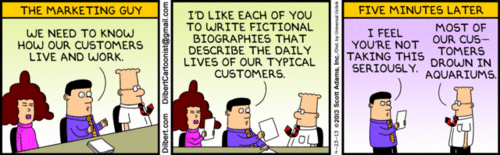
Basically, you are going to create fictional characters to represent the different types of personalities you have profiled so far. Creating fictional versions of customer personas that are loosely based on Jim and Jessica (and many other variations of their personas) helps you craft the perfect pitch.
Jim can be convinced by selling him the exquisite experience of a pleasant evening reading that great American novel, sitting on his porch sipping your wine. And, Jessica will be head over heels when she hears about the organic vinification methods and the pedigree of your customers.
Building customer personas helps open up your mind to the right questions and in turn find the right solutions. By stepping into the customer’s shoes, all your strengths and weaknesses are exposed. Lessons learnt will come in handy to tweak marketing campaigns, create remarketing strategies and to precisely position the brand in the market.
It takes time to build that crystal clear customer persona. By crunching and mining a lot of data that’s available in house and the ones that you can source from the outside, you’ll bring more clarity into the process.
A perfect customer profile emerges at the intersection of what you already know and what you can find out. With a good amount patience and a tub of elbow grease, you’ll get there sooner than you think!