
The ClinchPad Blog
Month
Many businesses use the absolute dollar value of a deal to determine the worth of a customer. What they fail to see is the potential to add thousands of dollars to their bottom line by leveraging the same customer base by way of word of mouth marketing.
When a customer forks out his or her hard earned cash to pay for your offering, that’s a huge validation of your legitimacy. Now, how awesome would it be to convince the good folks who are happy doing business with you to bring more people like them onboard?
Using word of mouth to build mindshare and marketshare is not a new marketing tactic. It probably is one of the oldest techniques in the world, but, it’s the highly competitive marketplace equations that make this cost effective marketing tool the most powerful one to generate more revenue.
Did I mention that word of mouth marketing is very cost effective? I guess I did. But, what people forget is that it takes a lot of time to convince people to say good things about you, even when there are only nice things to say about you.
The fact that somebody is willing to pay for your offering isn’t an indicator that they are ready to sing your laurels day and night. When someone recommends you to their peers and you bungle up that transaction, the customer’s reputation is tarnished in the process as well.
So, what does it take to make someone a loyal customer who will risk his reputation to help you out? Let’s check it out!
We’ve added the following improvements to the Pipeline View
An advanced lead creator
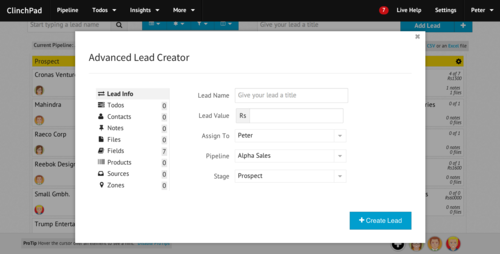
The current workflow for creating a lead involved typing in the lead name in the ‘Add Lead’ box on the top right corner of the Pipeline View. A new lead card would then be created which you could click on to add additional information such as contacts, notes, todos etc.
However, in case one was to enter multiple leads in succession, this workflow would get too tedious. To fix that, you can now create a lead along with additional information such as contacts, notes, todos etc without having to leave the Pipeline View. Clicking on the ’+’ icon next to 'Add Lead’ will open up a popup window.
Ability to add notes, todos and files to an existing lead
Notes, todos and files are the most common information that is added to existing leads. Instead of clicking on the lead card and navigating to their respective tabs, you can now view, edit and delete notes, todos and files right from the Pipeline View itself by just clicking on the 'x notes’, 'x of y todos’ or 'x files’ text on the lead cards. This will open up a popup window.
I’m a big fan of the open source software movement. I’m so proud to be a supporter of what open source software stand for - freedom, flexibility and security. In fact, we’ve built ClinchPad on top of best in the class open source frameworks and libraries.
I’m so biased, I could sing the laurels of open source all day long and then some. However, when I have to evaluate the merits and demerits objectively, there are some drawbacks to blindly embracing open source software.
In many cases, open source applications aren’t “fit it and forget it” solutions. It requires a lot of technical expertise to get them up and running. Be it open source CRM, ERP, help desk system or a CMS, a business has to employ a system admin or have a consultant on speed dial.
Let us take for instance the curious case of choosing an open source CRM for small businesses. Picking one that might be right for your business is a chore in itself.
To make things easier (!), you’ll have to hire a consultant to help you select the one that’ll fit your business processes and then hire a couple of developers to customize it to your workflow.
The custom development will go for a few weeks, if you’re lucky. Then there will a truck load of bugs that the dev team will take their own sweet time to fix for a hefty, recurring maintenance fee. So much for no barriers to entry!
Yes, I’m a product evangelist for a dynamic online Sales CRM and I do have vested interests to pull people away from choosing open source CRM software. However, it shouldn’t stop us from discussing the downsides objectively. Here are our arguments:
If you think all you need to clinch deals is a list and a phone, think again. Of course, you can make a lot happen with these resources, but then you would also be missing out on a lot more.
You could take your business to greater heights with a little planning and an excellent marketing tool called the sales pipeline.
Sales pipeline is a visual representation of your sales process. It is an arrangement of all your customers according to the phases of sales cycle they belong to. You can visualize it as a sales funnel which is used to filter down your “leads” to “customers”.
Your leads “trickle” down the sales funnel at every sales stage and results in the final outcome, that is a closed deal. So, logically, the very first step towards creating a well defined sales pipeline is to clearly list down the stages of your sales process.
In case you aren’t sure of the number of sales pipeline stages, simply write down the steps that are required to convert a prospect to your customer. It’s as simple as that. It is often advisable to keep the sales process short.
Too many stages often mean too much of data to be handled and a long winded buying cycle for a customer. Try making your sales process as lean as possible. In general, the stages of a sales process can look like this:
The path leading from creating initial awareness of a brand to selling the product or service is paved with challenges and opportunities. A sales funnel helps a business streamline the sales process to deal with the challenges and exploit the opportunities for maximum efficiency and RoI.
The concept of a sales funnel segregates the sales pipeline into various stages which track the conversion of a lead into prospects and the to actual sales.
Usually, at the top of the sales funnel you’ll have a large number of leads from a variety of sources after being targeted by your marketing efforts.
As we move down the funnel, some of the leads are qualified as prospects - those who are interested in your product and service after having been contacted by your firm.
At the narrow end of the funnel, a percentage of these prospects are converted into customers who have purchased your products after going through various sales pipeline stages.
Throughout this process, a firm has two goals:
Maximizing lead generation and brand awareness - to get more and more people ‘into the funnel’
Maximizing the percentage of people who move ‘down the funnel’ to the next stage with the end goal of increasing sales.
66% of small businesses in US don’t use a CRM. The most common reason heard from small business owners is that they are too “small” for having a systematic process of managing their sales. They also view the time spent setting it up the sales CRM, training themselves on it and entering data as lost time that could be spent on more productivity activities like selling. After all, who has the time or money in a resource strapped small business?
This is actually a valid viewpoint. CRM software is a $20.6B dollar market but 95% of this spending is by enterprises. This means all the top players in the market have built CRM software for large Fortune 5000 organizations which have huge armies of dedicated salespeople.
The drawback from the focus on enterprise by customer relationship management software providers has been most tools in the market are so complex that they are intimidating for these time strapped small business owners and teams to understand.
However, research shows that even using a large, complex CRM software can increase the win rate by 29% when used by small businesses. There are several advantages to having a small business CRM software that result in a higher win rate and productivity.
To put it simply, there is no debate on whether you should embrace modern technology such as sales CRM solutions in your organization as these following reasons outline:
“It’s really hard to design products by focus groups. A lot of times, people don’t know what they want until you show it to them.“
— Steve Jobs
Traditional factors that have influenced buying decisions for long have lost their sheen. All the celebrity endorsements, product placements and splashy multi million-dollar ad campaigns are just 140 characters away from becoming a big dud. Over the past few years, customers have taken control of the conversation from businesses.
No matter how big of a brand you are, customers are actually in the position of power. They don’t get carried away by all the pre sales blitz and are more focussed on what happens post sales. Brands that invest in offering customers a better experience get instant mindshare and a major chunk of the market relatively faster.
To begin with, you’ll have to understand the difference between a customer focused and a customer centric business. The former model does cater to its customers pleasantly as long as there is some monetary gain for them in doing so. Customer experience management isn’t their top priority.
Repeat sales, extended warranties, referrals - there has to be a quid pro quo for these businesses to go out of the way to make customers happy. Such companies rank better than their competition, but they believe in using band aids to heal all ailments.
On the other hand, customer centric businesses believe that happy customers are the bread and butter of their business. Delivering fabulous customer experience is in their DNA no matter where people fit in the sales pipeline. In fact, you can see every member in the company scramble to assist when a customer needs a helping hand.
The euphoria around customer centric business models has reached such a peak, it’s actually possible to build profitable businesses focussing only on keeping your customers happy and nothing else. Here’s how:
It’s not a bad thing for you to expect more and more people in your lead generation pool. The conversion rates across the board keep falling down and it’s a sound strategy to have the top of the sales funnel filled with as many qualified leads as possible.
Qualified is the keyword here. Getting people who might buy your offering to notice your brand and getting hold of their information for exploring the possibility of a pitch is what demand generation is all about.
Demand generation strategies focus on spreading awareness and make people warm up to your brand. Without much ado, let us jump right into the ideas that’ll help generate more demand for your business!