
The ClinchPad Blog
Month
Positioning a brand online is an exercise that takes months, if not years to come to fruition. It’s a mammoth undertaking that leverages a multitude of organic and inorganic digital marketing channels in a harmonious synergy.
Once you are successful in getting a pole position online, it doesn’t mean you’re done. An equal amount of hard work is required to retain that leadership position. You’ll have to adapt to new trends and make course corrections in line with your competitor’s strategy at a breakneck pace.
Auditing the digital marketing strategy in its entirety at regular intervals is one assured way of staying ahead of the curve. So, what metrics should a digital marketing audit take into account?
Email marketing is one of oldest channels of online marketing. It’s an often overlooked fact that email is one of the most nonintrusive modes of reaching out to an audience. They are free to open and read emails at a time and place of their convenience. It’s a pleasant alternative to cold calls and unannounced walk ins.
Over the years, the sheen of email marketing has lost its lustre quite a bit, thanks to the uncontrollable flood of email spam. Even so, being a very cost effective marketing tool, email marketing figures at the top of every marketer’s todo list.
So, you can bet the barn that you’ll always to competing for the attention of your audience without much room to maneuver beyond the email subjecline. Crafting emails that stand out in a crowded inbox is a tall order.
After the break, let us discuss a few ideas that will help you maximize the chances of getting your emails opened.
It would be a cliche to say that marketing has gone through a paradigm shift (if not many) since the advent of the Internet. Online marketing has levelled the playfield for companies of all sizes in more ways than one. Money isn’t the only factor that determines the reach of your brand any more. A healthy dose of creativity is all it takes for upstarts to unseat reigning goliaths.
Over the years, the complexity of marketing online has seen an exponential rise as well. You don’t get a ranking bump any more just by paying for a link farm. Today, online marketing has so many layers to it with more sophisticated ones added to the list ever so quickly.
In other words, there are so many moving parts in an online marketing strategy. Getting them all right isn’t what matters when you get started. But, making sure that you’ve taken into account all the obvious and most important ones is what matters.
Here’s a list of low hanging fruits that’ll let you see quick wins and lay a strong foundation for you to build on top of:
Where would we all be if there isn’t a Google anymore? It really is a scary thought! Almost every customer begins his buying process with quick search online. So, it makes a lot of sense to get that in order real quick.
SEO isn’t rocket science and throwing a boatload of money to reach the top position of search results isn’t a guaranteed win any longer. Paying a consultant blindly for boosting search engine rankings is downright deplorable.
As a business owner, it’s vital that you ask them to explain their strategies in detail and see if they are doing white hat or black hat SEO to start with.
You wouldn’t go by the book keeper’s word when it comes to your accounting right? Overseeing the SEO strategies is the online marketing equivalent of balancing your books. Like I said, it isn’t a tough nut to crack. See it as a pretty lengthy and slightly boring checklist, which it indeed is.
Figure out the keywords that you want to go after. Use the Google Keyword Planner to analyze the keywords with decent search volume. Look at your competition if you are in doubt.
Write a compelling web copy that isn’t stuffed with keywords. Get more relevant content onboard using a bunch of landing pages.
Avoid copy pasting content and duplicate content at all costs.
Keep the code clean and pay attention to the usual suspects - headers, meta tags, alt tags and the like.
Clearly map your 301 redirects and 404 error pages.
Build a search engine friendly sitemap.
Deploy the website in a fast, responsive server to speed up page load times.
Local SEO matters. Pay the dues to local listing and review sites.
Pay attention to International SEO if you are doing business across geographies. Use relevant language if you have the site translated to the local audience.
Use Google Webmaster Tools and get rid of crawling errors.
Focus on usability for better user experience, this will bring down bounce rate and boost conversions.
Get backlinks only from relevant, quality sources with good page rank and domain authority.
Use guest blogging as your tool to building linkbacks instead of paying for sketchy Fiverr offers.
Keep your blog updated at a regular pace.
Branch out beyond the traditional SEO strategies. Use videos, images, slides and other multimedia to diversify the mix of SEO enhancing content.
Stay on top of search engine algorithm updates and adapt. ‘Fit and forget’ doesn’t hold good when it comes to SEO.
It gets lonely on Google+. Still, keep that feed constantly updated.
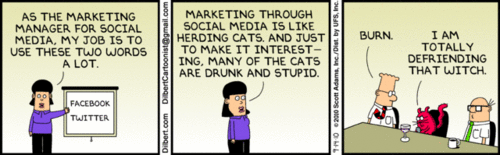
Twitter and Facebook strategies take up a huge chunk of the online marketing spend. Hashtags, retweets and likes dominate the metrics that determine the success of an online marketing campaign. With a combined user base of well over a billion users, the rush to tap that potential is understandable.
However, on the other side of the aisle is a social network that has a huge userbase of more than 250 million users with greater user engagement. Yet, it hardly finds a place in the tightly packed online marketing calendar. LinkedIn, the social network for professionals, or the place where suits and ties hang out, is overlooked by many businesses.
One big reason is it isn’t hip enough. There aren’t cool selfies to gawk at or cute cat videos to share. The “viral nature” of Facebook and Twitter is clearly amiss at LinkedIn.
Overlooking the fact that there have only been a handful of campaigns that have gone “viral”, businesses try to maximize the reach of their hashtags and mentions competing head on with their competitors making little headway.
The arguments to devote a fair share of time on a LinkedIn marketing campaign are quite compelling:
You get to connect with decision makers in an organization.
Be found by businesses who are looking for a fix for their real world problems
Reach the LinkedIn inbox of even those influencers who aren’t in your network.
Readily access the identity of the person who showed an interest in your business.
There are quite a few to add to this list and LinkedIn could complement your sales CRM in more ways than one. But, let us jump straight ahead to kickstart a LinkedIn marketing strategy that’ll get you results and leads!